Home Blog Page 50

#IncludeEveryone: Here are the #DIAA2019 Best Brands on Social Media.

On 4th February 2004, Facebook (TheFacebook) was founded. On 14th February 2005, YouTube was born. On 21st March 2006, Twitter was launched. On 24th February 2009, WhatsApp came to life. On 6th October 2010, Instagram was rolled out. And the story continues.

As of the end of 2018, the world had about 2.8 billion active Social Media users. With about 23 million sim-cards in circulation, Uganda had at-least 6 million Social Media users as of December 2018.

Uganda’s Social Media story is an interesting tale altogether. Firstly, Social Media was at the start disregarded as a pass time, somewhat lousy thing by the majority. Secondly, companies also originally disregarded it.

However, around 2008, a few tech savvy Ugandans led by the likes of HiPipo started using Social Media particularly Facebook as a preferred means of communication. By 2010, a few hundreds had either heard or used social media or both. The unreliable and expensive internet was the biggest obstacle.

Everything changed after 2010, with public agencies and private companies adopting Social Media as a marketing and customer support tool while Telecoms lowered internet costs and improved network strength.

But even at this point, there were all sorts of stories. The most popular ones involved individuals that opened social media accounts for artistes, companies and public agencies. When the time for transferring them came, the owners (those that opened the accounts) rightly asked for payment before they would hand them over. For some, these stand offs ended amicably while for others it was all manners of fighting.

Today, all serious entities are actively using Social Media for Marketing, Public Relations and Customer Experience among other things

A few years ago, social media quantity was the selling point. The long and short of social media was how many followers/fans do you have on a particular site. Currently, this narrative has improved for the better. It is now both a quality and quantity question.

While the more followers/fans you have, the wider your messages will reach, many pundits and observers now rate highly the quality of both your following and content. As such a brand can have 3 million Social Media followers altogether but offering them pathetic digital customer experience.  In that case, the 3 million followers are just a number.

Differently, a brand can have 500,000 Social Media followers altogether but offering them dedicated and high notch customer experience. Such a brand will be king!

This year, the category for Best Brand on Social Media has been sub-divided in to 2 categories – Consumer Goods and Financial Services, Telecommunication & IT.

The nominees for the #DIAA2019 Best Financial Services, Telecommunication and IT Brand on Social Media category are Africell, Airtel Uganda, Centenary Bank, DFCU Bank, MTN Uganda and Stanbic Bank.

On the other hand, the nominees for #DIAA2019 Best Consumer Goods Brand on Social Media are Bell Lager, Movit, Pepsi, Riham, Club Pilsner and Jumia.

While as, it possible to analyse and give a verdict on each of these nominated brands, doing so will be ‘perceived prejudice’ that may influence the choice of the ultimate winner. As such, we leave it for you to decide.

The overall winners for both #DIAA2019 Best Consumer Goods Brand on Social Media and DIAA2019 Best Financial Services, Telecommunication and IT Brand on Social Media will be determined by a Jury/Research Panel assessment and public survey/vote.

#IncludeEveryone: 5 Agencies battling for #DIAA2019 Best Digital Customer Experience for Utilities and Government Services Accolade.

In our review for #DIAA2019 Best Digital Customer Experience in Financial Services, Telecom and IT Sectors, we gave an elaborate definition for Customer Experience.

Liferay – a digital experience software/platform defines Digital Customer Experience as the sum of digital interactions between a customer and a company and the resulting impression that a customer walks away with.

“The broad umbrella of customer experience (CX) can cover anything from traditional customer service channels to new digital interfaces that people use to interact with companies. Digital customer experience (DCX) focuses on the latter, including both front-end services and back-office process optimization that ultimately benefits customers.”

The nominees for #DIAA2019 Best Digital Customer Experience for Utilities and Government Services are KCCA, NSSF, NWSC, UMEME and URA.

#IncludeEveryone: 5 Brands Nominated for #DIAA2019 Best Digital Customer Experience in Financial Services, Telecom, IT Sectors.

Customer Service was a very popular phrase a few years ago. However, it has since been frozen out and replaced by Customer Experience (CX).

Business Dictionary (www.businessdictionary.com ) defines Customer Experience as entirety of the interactions a customer has with a company and its products. “Understanding the customer experience is an integral part of customer relationship management. The overall experience reflects how the customer feels about the company and its offerings. Surveys, feedback forms and other data collection techniques help a company to determine the customer experience.”

Put differently, Customer Experience is a client’s journey with a brand or product or service with Customer Support being part of this journey.

Further; according to www.hotjar.com , the 6 things that cause bad customer experience are Long wait/response time, employees who don’t understand customers’ needs, unanswered/unresolved issues & questions, too much automation/ not enough human touch, nothing ( customers just love the brands), services that are not personalized and rude/angry employees.

Now that we know what customer experience is and what causes bad customer experience; we can comfortably give a verdict on which brand is offering the best digital customer experience in Uganda.

The #DIAA2019 Best Digital Customer Experience in Financial Services, Telecom and IT Sectors are Airtel, Centenary Bank, MTN Uganda, Stanbic Bank and Standard Chartered Bank.

#IncludeEveryone: Nominees for #DIAA2019 Best Community Banking.

Less than 10 million Bank accounts are currently operational in Uganda, compared to over 24 million Sim-cards in the market. With an estimated population of about 42 million people, the banking penetration is less than 25 per cent.

Most of these bank accounts are owned by urban dwellers, with very few in rural areas where the majority of Ugandans reside.

As such, if we are to achieve financial inclusion, it is crucial that more effort is put in converting the unbanked majority in to a banked population.

One initiative that is enhancing financial inclusion through bridging the banked-unbanked gap is community banking.

By definition, a Community Bank is according to www.wikipedia.com a depository institution that is typically locally owned and operated. “Community banks tend to focus on the needs of the businesses and families where the bank holds branches and offices. Lending decisions are made by people who understand the local needs of families, businesses and farmers. Employees often reside within the communities they serve.”

Community banks usually have specific products for the less-privileged groups mainly women and the youth.

The nominees for the #DIAA2019 Best Community Banking are Centenary Bank, FINCA, Post Bank Uganda, Pride Microfinance Limited, Finance Trust Bank and BRAC Uganda Bank.

All the 6 nominees have well-tailored products for the informal sector, marginalized and low income communities mainly the women, youth and people with disabilities (PWDs) largely living in rural and semi-urban areas. Such products include low interest group, women and youth loans among others.

#IncludeEveryone: And the #DIAA2019 Accolade for Best Cards Payment goes to?

In the ‘bold new digital world’, time is a very scarce resource with people very busy with their lives and things that improve or excite them or both.

As such, the lesser time one spends to accomplish a particular task, the more chances that s/he has to indulge in other things.

Before the introduction of Automated Teller Machines (ATM) cards, customers would queue in banking halls for hours before they would withdraw their hard earned monies.

This changed with the introduction of ATM cards that enable customers to conveniently access their funds from hundreds of ATM stations across the country.

It even became more interesting with the introduction of interconnected cards which would enable customers to visit any ATM station, include those of other banks and access their monies.

While there are Inter-switch cards, there are also VISA and Mastercards. The last two are internationally accepted, meaning that a customer with an active VISA or Mastercard can access and withdraw funds even when s/he is outside Uganda. In a nutshell, a trader is able to travel to China with just a card and withdraw money on arrival in Hangzhou.

Minus enabling local and international cash access, these cards also facilitate payments for goods and services. Be it on Amazon, Jumia, ITunes, Tidal, Apple Stores, Facebook and Twitter Ads; one can easily pay using their VISA or Mastercard. Indeed, the VISA / Mastercard is the ‘in thing’ and banks without them are losing clientele by the day.

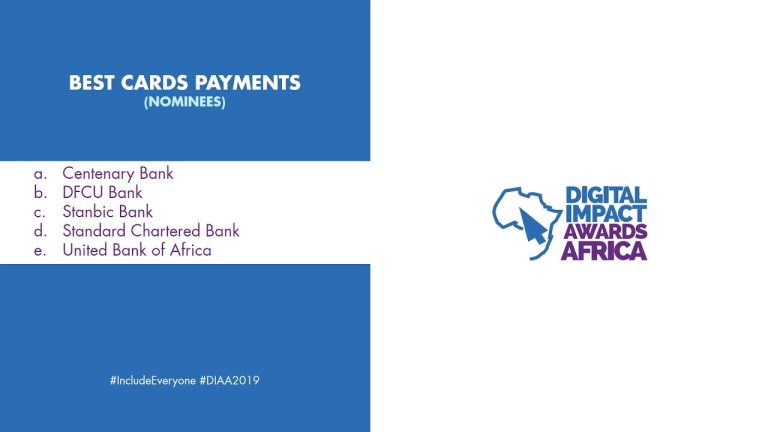
The category for Best Cards Payments seeks to reward a bank who ‘ATM Card’ services have been tried, tested and perceived to be more reliable than its peers. Not listed in any order of prominence, the nominees are Centenary Bank, DFCU Bank, Stanbic Bank, Standard Chartered Bank and United Bank of Africa (UBA).

#IncludeEveryone: 5 payment enablers nominated in #DIAA2019 Best Mobile Payment category.

In the days of our great grandparents, forefathers and mothers, barter trade was the mode of payment. This involved the exchange of goods and services for other goods and services.

Barter trade was replaced by ‘cash money’ that allowed people to pay for goods and services in cash. This revolutionized trade and business as someone would pay for the exact value of the product and service that she/he was purchasing.

Even though cash payments have been very popular, they continue to reduce by the day thanks to new solutions being introduced on the market.

Developed economies are largely cashless while developing countries like Uganda are equally heading that direction. www.cardguru.com defines a cashless economy as a financial environment that minimizes the use of physical cash by providing alternative channels for making payments and fosters a clean and digital economic culture. Under such a culture, people prefer electronic money and transactions to moving with hard cash.

This culture is fast growing in Uganda with hundreds of people now comfortable paying for goods and services using digital payments in addition to saving more in banks and mobile phones.

In the 2019 Digital Impact Awards Africa, five payment solutions are competing for the overall honour of best mobile payment. Listed not in any particular order, they are PESAPAL, Beyonic, Payway, MTN MoMopay, and Pebuu.

The overall winner for Best Mobile Payment will be determined by a Jury/Research Panel assessment and public survey/vote.

Under the theme #IncludeEveryone, Digital Impact Awards Africa is a platform that promotes Digital Inclusion, Financial Inclusion and Cybersecurity. Precisely; the Awards seek to recognize, celebrate and appreciate different individuals and organizations that are spearheading the use of digital mediums to better serve their communities.

HiPipo looks forward to host all the nominees and other players come 20th September 2019 at Kampala Serena Hotel. Contact the #DIAA2019 team to book your attendance package Standard ($1,595) for awards attendance Or Corporate ($3,450), Corporate Branded ($5,200) that will give you access to Include Everyone – Digital and Financial Inclusion Summit and Panel discussions with Digital Leaders

#IncludeEveryone: Here are the products competing in #DIAA2019 Best Saving and Lending category.

Almost every financial adviser will tell you that whenever you earn, you ought to save for the bad days tomorrow or the unforeseeable future.

On the other hand, the hard economic times majority of the population lives in mean that every once in a while, you will need to borrow from friends, loan sharks or credible lenders.

As such, thousands of Ugandans interact with Saving and Lending/Credit products on a daily.

That said, a few years ago, both borrowing and saving were tiresome, time consuming, complicated and somewhat impossible. This is no longer the case following the coming to the market of digital enabled, flexible and easy to use saving and credit products.

#IncludeEveryone: #DIAA2019 review for Best Digital Banking nominees.

A simple internet search for the key words ‘Digital Banking’ will return multiple results, with several sources giving related but somewhat different definitions.

According to www.avoka.com , Digital banking is the digitization (or moving online) of all the traditional banking activities and programs that historically were only available to customers when physically inside of a bank branch. Such activities include but not limited to Cash Deposits, Withdrawals, and Transfers, Accounts Management, Applying for Financial Products, Loan Management, Transacting and Paying Bills.

But, for whatever it is/not, Digital Banking involves transformation from traditional, physical, inside a hall mode of banking to personally managing your banking through USSD and internet enabled devices anywhere, any time.

With Digital Banking, there is nothing like a branch closing or opening as customers are able to self-serve themselves using their phones, ipads, tablets, laptops and desktops.

Click here for details about the Banks nominated in this category.

#IncludeEveryone: Digital Impact Awards Africa (#DIAA2019) Nominations Out.

HiPipo; the organizers of the annual Digital Impact Awards Africa have released the nominees for the 6th Digital Impact Awards Africa (#DIAA2019).  Digital Impact Awards Africa is Africa’s most important gathering of C-Level Executives, and senior Digital and IT executives.

The release of the nominations marks the end of a comprehensive entry submission and validation process that ran from June 6th 2019. #DIAA2019 grand finale is scheduled for 20th September 2019 at the Kampala Serena Hotel. The awards gala will be the climax of the Include Everyone – Digital and Financial Inclusion Summit that will happen on the same day. This summit will explore the strategic trends and technologies that are shaping the future of Digital, IT and business.

FIND OUT MORE

DANIDA and TradeMark EA sign Development Engagement Agreement.

0

Our Reporter.

10/07/2019 – Today, TradeMark East Africa and the Danish Government have signed the Development Engagement Document/ MOU. The Government of Denmark is supporting Government of Uganda through TradeMark East Africa to a tune of DKK 60 million (approximately USD 9million) over the four-year period from 2019 to 2022.

The Head of Mission of the Danish Embassy, Majbrit Holm Jakobsen signed on behalf of the Danish Government, while TMEA was represented by the Chief Technical Officer, Allen Asiimwe and the Country Director, Moses Sabiiti.

The Head of Mission of the Danish Embassy, Majbrit Holm Jakobsen noted: “We have signed an agreement between DANIDA and TradeMark East Africa Uganda Programme.  We are here to support the strategic plan for TradeMark so that they can continue doing the very good work that they have been doing in terms of making it easier to trade across borders in East Africa. DANIDA has been a long-time partner of TradeMark. We have worked with them for the last almost 10 years and have been very impressed with the results that they have been able to achieve over the years.

This engagement will support increased trade through removal of barriers and improvement of markets with focus on 1) Improved trading standards and reduced non-tariff barriers (NTB), 2) improved and more transparent trade processes and systems, and 3) improved trade regulatory environment.

Enhancing the collective power of women traders through associations, clusters and sectors is one of the biggest aspects of our (TradeMark EA) phase two because it makes it easier to interact with them plus connecting and linking them to the wider world. The only way of connecting them is through aggregations, through logistics centres like the one the TradeMark Uganda Programme is working on – Gulu Logistics Hub,” Allen Asiimwe, the TradeMark East Africa Chief Technical Officer said.

She added: “We will support women traders on market access, attaining the relevant standards, addressing the non-tariff barriers (NTBs), on ICT4Trade and many others. I believe UPSIDE (Uganda Program for Sustainable and Inclusive Development of the Economy) will enable us do that.”

Further, TMEA Country Director for Uganda and South Sudan: ‘’ Grateful to the Danish Government that funded the implementation of the Uganda National Single Window to the tune of USD 9Million. This support has already led to positive improvement in Uganda’s doing business rating. TMEA is working with Government Ministries Departments and Agencies and the private sector to ensure that the second phase of the Uganda Single Window leads to substantial reduction in time to import and export. The additional support of DKK 60 million will be utilised to support cross border trade, improved standards for key sectors that is expected to lead to more exports and more jobs created. TMEA is working closely with key leaders in Government and the private sector to ensure that the funded interventions are replicates and sustained’’

In Strategy 2, TMEA seeks to deepen engagement with borderland communities with the key aim of thinning borders so as to increase access to Markets. TMEA will take a two-pronged approach- build upon ongoing infrastructure work such as the One Stop Border Posts (e.g. Busia, Elegu, Mutukula) to address key trading challenges faced by both formal and informal cross border traders. This will not only cement Uganda’s position as a regional logistics hub for both informal and formal trade but will also further consolidate gains in increasing ease of doing business in Uganda.”

Cross border trade (CBT) is important in diversifying Uganda’s exports. Uganda’s cross border exports, account for between 25% and 35% of total exports. The informal cross-border export earnings in the Financial Year 2017/18 were estimated at US$ 595.51 million, representing 17.08% of Uganda’s exports. The main informal commodities included beans, maize, sugar, other grains, bananas, fish, among others.

DR Congo was the main informal partner of the country with total informal export trade amounting to US$ 291.48 million in 2017/18. It was followed by Kenya at US$ 149.94 million; Rwanda at US$19million.

Despite having a steadily improving trade environment, Uganda still faces some constraints in cross border trade. These include:

  • The lack of appropriate infrastructure;
  • Non-tariff barriers to trade and costly trading standards;
  • Gaps in transparent trade processes and systems;
  • A sub-optimal regulatory environment;
  • Limited export capability;
  • Exclusion of women and small businesses; and
  • Uncoordinated support to CBT.

This engagement will support increased trade through removal of barriers and improvement of markets with focus on:

  • Improved trading standards and reduced non-tariff barriers (NTB),
  • Improved and more transparent trade processes and systems,
  • Simplification of border processes and documentation for informal traders,
  • Enabling SMES access regional and international markets
  • Improved private sector led advocacy for trade
  • Implement e-Commerce platforms and
  • Improved trade regulatory environment.

The support from DANIDA builds on a number of interventions implemented by Government of Uganda through TradeMark East Africa including:

  • Construction and operationalisation of the 4 One Stop Border Posts at Busia OSBP, Mutukula OSBP, Mirama Hills OSBP and Elegu OSBP;
  • Upgrading customs management systems to improve the trade environment;
  • Implementation of the Uganda National Single Window.
  • Improving standards and elimination of NTBs;
  • Government of Uganda through Ministry of Trade, Industry and Cooperatives and TradeMark East Africa launched the Uganda Cross Border Strategy in 2017 that seeks to create simple procedures for small cross border traders and avail key trade information to this segment of traders;
  • Ministry of Trade, Industry and Cooperatives signed off the Cross-Border Trade at Mirama Hills One Stop Border Post and Mutukula One Stop Border Post. The Charter basically highlights the rights and obligations of border official and its users, including informal traders.