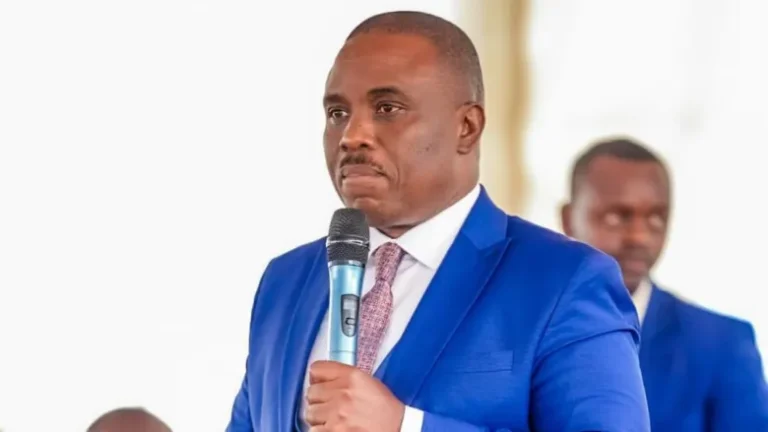
Former Kampala Mayor and opposition People’s Front for Freedom (PFF) president Erias Lukwago was arrested at his residence in Wakaliga on Monday morning under circumstances that remain unclear.
Details surrounding the operation and any case linked to his arrest were not immediately available. Neither the police nor other security agencies had commented on the reported arrest by the time of publication.
Lukwago had been scheduled to appear for a television interview at his Kampala office but later opted to conduct it from his residence, according to sources close to him. He was also preparing to legally serve court documents on Chief of Defence Forces Gen Muhoozi Kainerugaba, according to his party, the PFF.
Boda boda riders in the neighbourhood said they noticed security operatives in the area as early as 6:00 a.m. They reported seeing one vehicle without number plates and another with registration plates, carrying an estimated eight people dressed in military uniforms and civilian clothing.
Witnesses told the Monitor that the operatives entered the premises by scaling the perimeter fence before moving inside the house of the opposition politician and lawyer. Lukwago is currently part of the defence team representing detained veteran opposition figure Dr Kizza Besigye in his treason-related case.
Monitor journalist Ibrahim Kavuma, who was inside the house at the time of the arrest, said he heard operatives issuing loud commands to the ex-mayor’s wife and slamming doors as they demanded to know Lukwago’s whereabouts before he was later “captured.”
Operatives also momentarily seized devices from those found inside the house at the time.
In an apparent reference to the operation, Gen Muhoozi later posted on social media: “I have captured a FOOL and taken him to the basement!”
However, the Chief of Defence Forces did not identify the individual he was referring to, and it was not immediately clear whether the post was related to Lukwago’s reported arrest. The post remained online hours after the operation.
Lukwago’s party, the People’s Front for Freedom, has condemned the arrest, accusing the government of using security agencies to suppress political dissent.
“Instead of respecting the rule of law, the regime has chosen military might to shield themselves from legal accountability and choke the voices of democratic change,” the party said in a statement on X. “This is the height of state-sponsored lawlessness.”
The party added: “We want to send a clear message to the dictator and his tools of oppression: intimidation cannot and will not deter our resolve. You can blockade a house, but you cannot blockade the burning desire of millions of Ugandans fighting for freedom and democratic change.”
As of Monday afternoon, several key questions remained unanswered. No security agency had issued a statement confirming the arrest or explaining the legal basis for the operation. It was not clear whether Lukwago had been formally charged with any offence or whether he had been produced before a court.
The circumstances surrounding the operation could not be independently verified, and it remains unclear why military personnel would be involved in arresting a civilian opposition leader when police have jurisdiction over such matters.
Lukwago, a prominent lawyer and veteran opposition figure, has been a vocal critic of the government for years. His arrest is likely to draw condemnation from civil society organisations and diplomatic missions, as well as further strain relations between the government and opposition.
Lukwago’s legal team has not yet issued a statement, but it is expected that they will seek to establish his whereabouts, access him, and challenge the legality of his detention. If he is not produced in court within 48 hours, his lawyers may file an application for habeas corpus, demanding that the state justify his continued detention.
For now, the former Kampala mayor’s location and legal status remain unclear. His party has called on the public and the international community to demand his immediate release.
Christopher Okello Onyum, sentenced to death for the murder of four toddlers at a daycare centre in Ggaba, has appealed both his conviction and sentence, arguing that the trial court failed to properly evaluate the evidence and wrongly rejected his insanity defence.
Onyum filed a notice of appeal before the Court of Appeal challenging the 30th April judgment of the High Court, which found him guilty of murdering four children at a daycare centre in the Ggaba suburb of Kampala.
Court records show Onyum is seeking to overturn the decision of Justice Alice Komuhangi Khaukha, who convicted him of the murders of Eteku Gideon, Keisha Agenorwoth Otim, Sseruyange Ignatius, and Odeke Ryan.
In his memorandum of appeal dated 12th June, Onyum argues that the trial judge failed to properly assess the evidence before reaching a guilty verdict.
“That the Learned Judge erred in law and fact when she failed to properly evaluate the evidence before her thereby arriving at a wrong conclusion and occasioned a miscarriage of justice,” the appeal states.
He also challenges the court’s rejection of his claim that he was suffering from a mental illness at the time of the killings.
“That the Learned trial Judge erred in law and fact by not properly evaluating the medical evidence regarding the mental status of the Appellant thereby arriving at a wrong decision,” the appeal adds.
Onyum further argues that the death sentence imposed on him was excessive and should be set aside or reduced. The appellant is asking the Court of Appeal to quash the convictions, set aside the sentence, and order his release.
The case stems from the killing of four children at a daycare centre in Ggaba on 2nd April 2026, an incident that shocked the country and sparked widespread outrage. The victims, all toddlers, were attacked in a place where parents had entrusted their children to safety and care.
While sentencing him, Justice Komuhangi described the murders as falling within the “rarest of rare” category deserving the maximum penalty.
The judge rejected the insanity defence, ruling that medical evidence presented before court did not support claims that Onyum was mentally ill when the offences were committed.
“The accused was very sane in April when committing these offences. Therefore, his defence of insanity won’t help him,” she ruled.
In imposing sentence, the court cited the vulnerability of the victims, the circumstances of the attack, and what it described as the convict’s lack of remorse.
Justice Komuhangi also stated that she believed the killings were linked to ritual sacrifice, saying she could find no other explanation for the attack on children in a place expected to provide safety and care.
That finding, while not a formal part of the conviction, added a chilling dimension to a case that had already gripped the nation.
The death sentence was welcomed by relatives of the victims and residents who attended the mobile court session in Ggaba, with some applauding the ruling. For many in the community, the swift conviction and harsh sentence were seen as justice served.
Now, with Onyum’s appeal, that sense of closure may be delayed.
The Court of Appeal is expected to fix a hearing date for the appeal. The court will review the trial record, hear arguments from Onyum’s legal team and the prosecution, and determine whether the High Court made errors of law or fact that warrant overturning the conviction or reducing the sentence.
If the appeal fails, Onyum will remain on death row. If it succeeds, he could be acquitted, granted a new trial, or have his sentence reduced to a lesser penalty, such as life imprisonment.
For the families of the four toddlers who lost their lives, the appeal reopens wounds that had only recently begun to heal.
Uganda’s greatest export may not be something manufactured in a factory. It may be something that already exists — the roar of a lion at dawn, the silence of a mist-covered forest, the rhythm of cultural traditions, the beauty of the Nile, and the stories carried by generations of communities.
The question facing Uganda is no longer whether we have a tourism product. We do.
The bigger question is whether we can transform this extraordinary natural and cultural wealth into a sustainable jobs machine for the millions of young Ugandans entering the workforce every year.
At Avenoir Safaris (U) Ltd, we believe tourism’s biggest opportunity is not simply bringing visitors into Uganda. It is building an ecosystem where every journey creates economic value for a young guide, a creative storyteller, a farmer, a conservationist, a transport provider, a designer, a chef, and an entrepreneur.
Tourism must evolve from being viewed as an industry of hotels and game drives into a national platform for youth enterprise. The future of tourism is experiences, not just destinations For decades, Uganda’s tourism narrative has largely been built around a few powerful icons in gorillas, wildlife and national parks.
These remain priceless assets. But the future traveler is changing.
Today’s high-value traveler is not only searching for what they can see. They are searching for what they can feel, learn and remember. They want to run through landscapes, cycle through communities, experience local cuisine, understand ancient traditions, participate in conservation, document stories and connect with people.
This is where Uganda can create thousands of new jobs.
A young Ugandan should not only dream of becoming a tour guide. They should see tourism as a space where they can become an adventure entrepreneur, a filmmaker, a photographer, a cultural interpreter, a hospitality specialist, a digital marketer, an event organiser, a conservation expert or a creator building global audiences around Uganda. Tourism needs to create careers beyond the traditional value chain.
Our priority: Build a tourism economy around young Ugandans
At Avenoir, our belief is that Uganda needs to move from a destination-selling model to an experience-creating model. The difference is significant.
Selling a destination means a visitor comes, takes photos and leaves. Creating an experience means the visitor connects with people, stays longer, spends more, and creates opportunities throughout communities.
This is why we believe the country’s priority should be developing a national experience economy.
Imagine a young entrepreneur in Kisoro creating cultural mountain experiences around gorilla trekking. Imagine a youth group in Jinja building Nile adventure packages combining kayaking, cycling and storytelling. Imagine young creatives documenting Uganda’s landscapes through films and digital platforms that attract global travelers. Imagine communities around national parks becoming shareholders in tourism rather than just neighbours to conservation areas.
That is where job creation at scale happens. Tourism must become Uganda’s largest youth entrepreneurship platform The private sector will remain the biggest creator of jobs, but it requires an environment that allows small tourism businesses to grow.
Many young Ugandans have ideas but lack access to mentorship, financing, market exposure and professional networks.
A tourism entrepreneurship ecosystem could change this. Government, investors and private operators can work together to support:
– Youth-led tourism startups
– Community tourism enterprises
– Digital tourism platforms
– Adventure and sports tourism businesses
– Conservation-based businesses
– Hospitality innovation
– Creative storytelling ventures
The next generation of tourism companies should not only be owned by international investors. They should be built by Ugandans who understand the land, the culture and the stories.Uganda’s tourism brand must become a story the world follows
The world is not short of beautiful places. It is short of meaningful experiences.Uganda’s competitive advantage is not only its landscapes. It is its authenticity. The future of tourism marketing should therefore go beyond advertising parks and attractions.
It should tell human stories.
The story of the ranger protecting a species.
The farmer supplying fresh produce to a lodge.
The young guide who turns knowledge of birds into a career.
The community preserving traditions for future generations.
When people connect with these stories, they do not just visit Uganda. They become ambassadors for it.
The road ahead, Uganda has the ingredients to become one of Africa’s most compelling tourism economies. But unlocking that potential requires a shift in mindset.
Tourism should not only be measured by visitor numbers. It should be measured by:
How many young people are earning from it?
How many businesses are being created?
How many communities are benefiting?
How much local talent is being developed?
At Avenoir Safaris (U) Ltd, we believe Uganda’s tourism future belongs to a generation that does not just inherit the beauty of this country but builds an economy around it.
The forests, rivers, mountains and cultures are already here.
Now we must build the systems that allow every Ugandan to benefit from them. Because the greatest tourism story Uganda can tell is not only about what visitors discover when they arrive.
It is about what Ugandans build because they came.I kept the tone aligned with HiPipo Money’s economic/development style while positioning Avenoir as a thought leader in tourism innovation, not just a safari operator.
Uganda's natural wealth — gorillas, the Nile, 1,000+ bird species — is already generating jobs. But tourism is punching well below its weight. With the right reforms, it could be Uganda's most powerful tool for employment at scale. Read the blog: https://t.co/cNB3gYnEXm
— World Bank Africa (@WorldBankAfrica) June 13, 2026
For thousands of years, humanity has been obsessed with movement. We built roads for horses, railways for trains, highways for cars, runways for aeroplanes, and digital networks that allow information to travel around the world in milliseconds. Yet despite all our advances, one of the most common forms of transportation remains remarkably unchanged: walking.
Every day, billions of people walk through streets, office buildings, shopping centres, airports, schools, hospitals, and public spaces. Walking is so ordinary that most people rarely think about it. Yet as cities become larger, denser, and more crowded, the simple act of moving from one place to another is becoming an increasingly important part of urban life.
This is why an experiment emerging from South Korea is attracting attention worldwide. Urban planners and researchers have been testing dedicated pedestrian lanes that separate fast walkers from slower walkers in busy public areas. At first glance, the idea may appear surprisingly simple. Some might even laugh at the concept. After all, can walking really be important enough to require separate lanes?
The answer reveals something profound about the future of cities.
Modern urban life is built around constant movement. People commute to work, rush to meetings, navigate transit stations, visit shopping districts, and move through crowded public spaces every day. Yet unlike roads, which are carefully designed with traffic lanes, speed limits, signs, and regulations, sidewalks often operate without any structure at all.
As a result, pedestrians with completely different needs are forced to share the same limited space. A commuter trying to catch a train moves alongside tourists taking photographs. Elderly citizens hurry alongside university students. Parents pushing strollers navigate around business professionals rushing to meetings. Some people want to move quickly. Others want to move comfortably. Everyone is trying to reach a destination, but not everyone is travelling at the same pace.
These interactions create friction.
Most people do not consciously notice this friction because it has become a normal part of everyday life. Yet psychologists and urban researchers increasingly understand that many of the stresses people experience do not stem solely from major life events. They also stem from hundreds of small frustrations that recur throughout the day.
A person walks behind a slow-moving group and becomes irritated. Another feels pressured because people behind them are moving faster. Someone misses a train because of congestion on a walkway. Another spends several minutes navigating through a crowded station. None of these events is life-changing, but together they contribute to mental fatigue and stress.
This phenomenon is known as cognitive load. Every time people are forced to make adjustments, avoid obstacles, change direction, or deal with unnecessary interruptions, the brain expends energy. By the end of the day, these seemingly insignificant experiences add up to real psychological strain.
South Korea’s pedestrian lane experiment is therefore not simply about helping people walk faster.
It is about reducing friction in daily life.
This principle has quietly driven some of humanity’s most successful innovations. Elevators reduce the effort required to climb stairs. Escalators reduce physical strain. Digital payments eliminate the need to carry cash. Online shopping removes unnecessary travel. Artificial intelligence reduces repetitive work. Every major innovation succeeds because it removes friction between people and their goals.
Separate pedestrian lanes apply the same philosophy to urban movement. By allowing individuals to walk at their preferred pace, cities can create smoother, more predictable, and potentially less stressful environments. Fast walkers maintain momentum. Slow walkers feel less pressure. Elderly citizens gain confidence. Families move more comfortably. Everyone benefits from a system that better reflects human behaviour.
The deeper significance of this experiment lies in what it says about the future of urban design.
For much of the twentieth century, cities were designed around infrastructure. Success was measured by roads built, bridges constructed, and buildings completed. Increasingly, however, the world’s most advanced cities are shifting toward a different philosophy. They are focusing on experience.
The question is no longer simply whether infrastructure exists.
The question is whether it works well for people.
A truly smart city is not necessarily the city with the tallest skyscrapers or the most sophisticated technology. A smart city understands human behaviour and uses that understanding to improve daily life. It recognises that efficiency, comfort, safety, accessibility, and well-being are just as important as physical infrastructure.
This shift is being accelerated by digital technology. Modern cities generate enormous amounts of data through sensors, cameras, transportation systems, mobile devices, and connected infrastructure. Artificial intelligence can analyse movement patterns, identify congestion points, predict pedestrian behaviour, and help planners optimise public spaces with unprecedented precision.
For the first time in history, cities can observe and understand how people actually move rather than relying solely on assumptions.
This capability is transforming urban planning, transportation, public safety, and even healthcare.
The connection to healthcare may not seem obvious at first, but it is becoming increasingly important. Medical experts now recognise that health is influenced by far more than hospitals, clinics, and medicines. The environments in which people live play a critical role in determining physical and mental well-being.
Stress has emerged as one of the defining health challenges of modern society. Anxiety, burnout, hypertension, cardiovascular disease, and sleep disorders are increasingly linked to the pressures of everyday life. Long commutes, congestion, overcrowding, noise, uncertainty, and constant interruptions all contribute to declining well-being.
As a result, city design is increasingly becoming a public health issue.
A city that reduces stress can improve health outcomes.
A city that encourages walking can reduce obesity.
A city that improves mobility can increase productivity.
A city that minimises daily frustrations can contribute to better mental well-being.
Urban planning and healthcare are becoming more interconnected than ever before.
For Africa, these lessons are particularly relevant. The continent is undergoing one of the fastest urban transformations in human history. Cities such as Kampala, Nairobi, Lagos, Kigali, Accra, Lusaka, Johannesburg, and Dar es Salaam continue to grow rapidly as millions of people move into urban centres in search of opportunities.
The decisions made today will influence how hundreds of millions of Africans live, work, move, and interact for generations.
Will future cities prioritise people or vehicles?
Will urban spaces promote wellbeing or increase stress?
Will technology digitise existing challenges, or will it help create fundamentally better experiences?
These are no longer theoretical questions. They are becoming urgent development priorities.
The same philosophy driving South Korea’s pedestrian experiment can be applied across many sectors. The goal is not merely to introduce new technology. The goal is to remove barriers that make life unnecessarily difficult.
This principle is equally relevant in healthcare. Across Africa, millions of people face challenges accessing medical services due to distance, cost, workforce shortages, and fragmented healthcare systems. Digital health platforms such as My Doctor are helping address these barriers by bringing healthcare closer to people through telemedicine, remote consultations, digital records, and AI-enabled support systems.
Just as separate walking lanes reduce friction in movement, digital health reduces friction in healthcare access.
Both innovations seek to achieve the same outcome: making essential services more accessible, efficient, and human-centred.
The South Korean experiment ultimately represents something much larger than pedestrian management. It reflects a growing recognition that progress is not always about grand inventions or billion-dollar infrastructure projects. Sometimes progress comes from understanding how people live and finding ways to improve everyday experiences.
The cities of the future will not be judged solely by the sophistication of their technology. They will be judged by how effectively they improve the lives of the people who inhabit them.
Because in the end, the true purpose of innovation is not simply to build smarter systems.
It is to build better lives.
And sometimes, that journey begins with something as simple as allowing people to walk at their own pace.
For decades, sending money into Africa followed an exhausting pattern.
Long queues. High fees. Slow settlement. Complex paperwork. Poor exchange rates. And systems that often felt designed more for institutions than for ordinary people.
Families accepted these frustrations because they had little choice.
If a mother needed school fees urgently, the money had to move somehow. If a trader depended on diaspora support for inventory, delays had to be tolerated. If a migrant worker wanted relatives to survive another month, expensive transfer fees became part of the sacrifice.
Then a new generation of African FinTech companies arrived with a different idea:
What if moving money across borders could feel as simple as sending a message?
That question helped trigger one of the most important transformations in Africa’s digital finance history.
Today, companies such as Flutterwave, Chipper Cash, and a growing ecosystem of remittance-focused FinTech innovators are rapidly reshaping how money enters, moves through, and circulates across African economies. Their platforms are helping reduce transfer friction, improve settlement speed, lower transaction costs, integrate mobile money ecosystems, and connect Africa more deeply to the global digital economy.
The implications go far beyond remittances.
Because increasingly, the battle over cross-border payments is becoming a battle over the future infrastructure of African commerce itself.
Africa’s remittance economy is enormous.
Sub-Saharan Africa received approximately US$54 billion in remittance inflows in 2023, according to World Bank estimates. Millions of households depend on diaspora money for:
education,
healthcare,
rent,
business survival,
agriculture,
emergencies,
and household resilience.
Yet historically, remittance systems often remained expensive and inefficient.
Traditional banking channels could charge extremely high transfer costs, sometimes averaging roughly 11.5% in certain corridors. Transactions passed through multiple intermediaries, increasing delays and reducing the amount ultimately reaching families.
This created a powerful market opportunity.
The remittance problem was not simply financial.
It was infrastructural.
And infrastructure gaps create space for innovation.
Flutterwave became one of the strongest symbols of this new FinTech wave.
Founded in Nigeria, the company initially gained prominence by simplifying payments for African businesses and merchants. But its broader significance came from helping build infrastructure connecting African financial systems more efficiently to global commerce networks.
Flutterwave recognised something critical early:
Africa’s digital economy could not scale properly if businesses and consumers struggled to move money across borders easily.
Its infrastructure increasingly enabled:
international collections,
merchant payments,
card integration,
bank transfers,
mobile money interoperability,
and cross-border settlement support.
Instead of forcing African businesses to navigate fragmented payment systems independently, FinTech infrastructure providers began acting as connective financial layers between local economies and global commerce.
This was transformative for SMEs.
A business in Lagos could receive international payments more smoothly. A merchant in Nairobi could integrate digital checkout systems more easily. A creator in Kampala could access broader online commerce opportunities. A startup could launch cross-border operations faster.
The payment infrastructure itself became an enabler of entrepreneurship.
Chipper Cash emerged with a different but equally powerful angle.
The platform focused heavily on peer-to-peer cross-border transfers and low-cost digital payments across African markets. Its mobile-first model reflected a deep understanding of Africa’s financial realities:
mobile-driven behaviour,
low-value transaction economies,
cross-border communities,
and growing youth adoption of digital finance.
Chipper Cash’s rapid growth reflected something larger than app popularity.
It reflected demand for frictionless African money movement.
Historically, moving money between African countries could sometimes feel harder than sending money internationally outside the continent. Fragmented systems, disconnected mobile money networks, currency challenges, and regulatory complexity created barriers to regional financial integration.
FinTechs began challenging this fragmentation directly. And consumers responded quickly.
Because when systems become:
cheaper,
faster,
more transparent,
and easier to use,
adoption accelerates naturally.
The rise of these FinTech platforms reflects a deeper structural shift happening across Africa’s financial ecosystem.
Historically, cross-border finance was dominated primarily by:
banks,
correspondent banking networks,
and traditional money transfer operators.
Today, the ecosystem is becoming far more competitive.
FinTechs now compete aggressively across:
remittances,
merchant payments,
digital wallets,
API infrastructure,
mobile interoperability,
and embedded financial services.
This competition matters enormously. Because competition reduces friction. And reducing friction unlocks economic participation.
Mobile money integration has been especially important.
Unlike many developed economies heavily dependent on card systems, Africa’s financial landscape evolved through mobile wallets and telecom-led digital finance ecosystems. FinTechs capable of integrating mobile money into cross-border payment systems therefore gained major advantages.
This allowed remittances to move beyond physical cash collection toward:
instant wallet settlement,
digital merchant payments,
savings integration,
and broader participation in digital financial ecosystems.
The significance extends beyond convenience.
Digital remittances increasingly create transaction histories that can support:
savings,
lending,
insurance,
merchant financing,
and broader financial inclusion.
The transfer itself becomes financial data.
And in modern economies, financial data increasingly determines access to opportunity.
The speed advantage is equally transformative.
Traditional cross-border transfers could take days to settle.
FinTech platforms increasingly reduced settlement windows dramatically.
For households surviving on thin margins, speed matters.
A delayed transfer may affect:
medical emergencies,
school attendance,
food security,
business operations,
or rent payments.
Fast settlement therefore becomes more than technical efficiency.
It becomes social resilience.
Transparency has also become a major competitive weapon.
These backend systems may quietly become some of the most valuable infrastructure assets in Africa’s digital economy.
Because in the future economy, whoever controls payment connectivity may increasingly shape commerce itself.
For HiPipo Money, this evolution represents one of the most important realities of Africa’s digital transformation:
The continent is no longer simply adopting global financial systems.
It is increasingly building its own.
This aligns strongly with broader ecosystem conversations around:
digital inclusion,
FinTech innovation,
interoperability,
cross-border trade,
mobile money,
and financial infrastructure modernisation championed through initiatives such as the Digital Impact Awards Africa (DIAA), Include Everyone, Women in FinTech, and wider digital transformation ecosystems.
Because ultimately, remittance FinTech innovation is not just about sending money faster.
It is about expanding economic possibility.
A migrant worker keeping more of their earnings. A small business receiving funds instantly. A creator selling globally. A trader moving money regionally. A household surviving crisis more efficiently. A continent becoming more financially connected to itself and to the world.
Most users may never think deeply about the APIs, settlement engines, interoperability frameworks, or backend systems powering their transactions.
But quietly, these FinTech platforms are rebuilding the movement of money across Africa.
And in many ways, they are helping define what the future architecture of African finance will look like.
There is something deeply powerful about timeless African music.
Decades pass. Technologies evolve. New genres emerge. New stars dominate headlines. Entire generations grow up under completely different cultural realities.
Yet somehow, certain African songs continue breathing through time as though they were created yesterday.
That is the mystery and power of true musical greatness.
Across Uganda and the rest of Africa, legendary artists from previous generations continue commanding emotional respect long after their passing. Whether it is the music of Philly Lutaaya, Elly Wamala, Herman Basudde, Paul Kafeero, Jimmy Katumba, Lucky Dube, Miriam Makeba, Fela Kuti, Franco Luambo, Papa Wemba or many others across the continent, one thing becomes undeniable:
Their music survived time.
Their songs still dominate weddings, road trips, bars, radio stations, family gatherings, cultural events, Christmas celebrations, live band performances, and emotional moments across Africa. Younger generations who never witnessed these legends perform live still somehow connect deeply with their music.
That level of longevity cannot happen accidentally.
And it forces an important question upon Africa’s modern music industry:
What exactly did the older generation understand about music that many artists today are slowly forgetting?
Because despite modern studios, advanced software, digital marketing, streaming platforms, artificial intelligence, high-end cameras, and improved production technology, much of today’s music still struggles to achieve the emotional permanence many older African songs achieved decades ago.
Why?
The answer goes deeper than nostalgia.
Many people assume older music feels special simply because societies tend to romanticize the past or respect deceased artists more generously. While nostalgia certainly plays a role, it cannot fully explain why songs from previous generations continue emotionally overpowering newer music in many cases.
The truth is simpler:
Many of Africa’s fallen musical legends were exceptional craftsmen.
They approached music differently.
One of the biggest differences is that many legendary African musicians were not merely recording artists, they were complete musicians.
Most understood music technically. Most performed extensively. Many played instruments. Many studied live performance deeply. Many understood melody construction, instrumentation, harmony, vocal arrangement, rhythm dynamics, and emotional storytelling from practical experience.
They understood the anatomy of music itself.
That matters enormously.
Today, many artists enter recording studios without understanding basic musical structure. Some cannot identify musical keys. Others depend entirely on producers to shape their songs. Many imitate trending sounds without understanding why those sounds emotionally connect with audiences in the first place.
But older African musicians approached music organically.
Their songs were carefully constructed experiences.
The instrumentation felt intentional. The melodies felt patient. The lyrics felt thoughtful. The emotional delivery felt believable. The storytelling felt lived.
And perhaps most importantly, the songs carried soul.
Take Philly Lutaaya for example.
Nearly every Christmas season in Uganda and parts of East Africa still reintroduces his Christmas songs to audiences naturally. Decades later, those songs continue feeling emotionally aligned with the spirit of Christmas itself.
Many newer Christmas songs have been released over the years. Some are technically cleaner due to modern production tools. Yet many listeners still emotionally prefer Philly Lutaaya’s originals.
Why?
Because he understood emotional atmosphere.
His songs were not simply seasonal releases. They carried emotional truth.
That same emotional permanence appears across Africa’s musical legends.
Lucky Dube still emotionally moves audiences decades later because his music addressed humanity, injustice, spirituality, struggle, freedom, pain, and hope in ways that transcended language and borders.
Fela Kuti still feels relevant because his music carried fearless identity, political consciousness, rebellion, and unmistakable originality.
Papa Wemba and Franco Luambo built music rich with rhythm, instrumentation, choreography, elegance, and emotional sophistication that still influences African music today.
Their songs continue surviving because they were built carefully.
And perhaps that is the second major difference between older generations and much of modern African music culture:
They took time.
Today’s entertainment economy rewards speed aggressively. Social media pressures artists to constantly release. Viral culture encourages quick production cycles. Algorithms reward frequency more than refinement.
As a result, many artists now create music hurriedly.
A song is announced today. Recorded tomorrow. A video is shot immediately. The release happens within days.
The pressure to remain visible often produces music that trends briefly but ages quickly.
Timeless music rarely emerges from creative panic.
Africa’s musical legends often spent significant time refining songs. Lyrics were selected carefully. Instrumentation was intentional. Vocal delivery matched emotional context. Arrangements evolved patiently. Songs matured before reaching audiences.
That patience mattered.
Another major difference was motivation.
For many older African musicians, music was first a passion before it became business. They respected the art deeply. They studied performance. They rehearsed extensively. They valued emotional impact. They prioritized craftsmanship before commercial reward.
Today, many artists understandably enter music searching for financial survival, visibility, or escape from poverty. There is nothing wrong with wanting success. The problem begins when financial desperation completely replaces artistic discipline.
That shift changes everything.
Instead of originality, imitation dominates. Instead of emotional depth, sensationalism dominates. Instead of mastery, shortcuts dominate. Instead of storytelling, noise dominates.
The older generation often approached music differently.
They created songs designed to outlive moments.
That is why their music still breathes decades later.
Another overlooked factor is emotional honesty.
Many African legends sounded believable because they sang from lived experience. Their songs carried real struggle, spirituality, heartbreak, joy, wisdom, love, social commentary, humor, and vulnerability.
Audiences trusted them emotionally.
And emotional trust is one of the foundations of timeless music.
People continue replaying songs when they continue finding themselves inside those songs years later.
Ultimately, the greatness of Africa’s fallen musical heroes cannot simply be explained by nostalgia or historical luck.
Their music survived because it was built on powerful foundations:
Passion. Professionalism. Technical understanding. Patience. Originality. Emotional honesty. Respect for the craft.
Those qualities transformed ordinary songs into cultural memory.
And perhaps that is the greatest lesson modern African artists must understand moving forward.
Technology alone will never create timelessness. Virality alone will never create legacy. Fame alone will never create emotional permanence.
Timeless music still demands what it has always demanded: craftsmanship, discipline, emotion, study, identity, truth, and deep respect for the art itself.
Because the songs that survive generations are rarely the loudest.